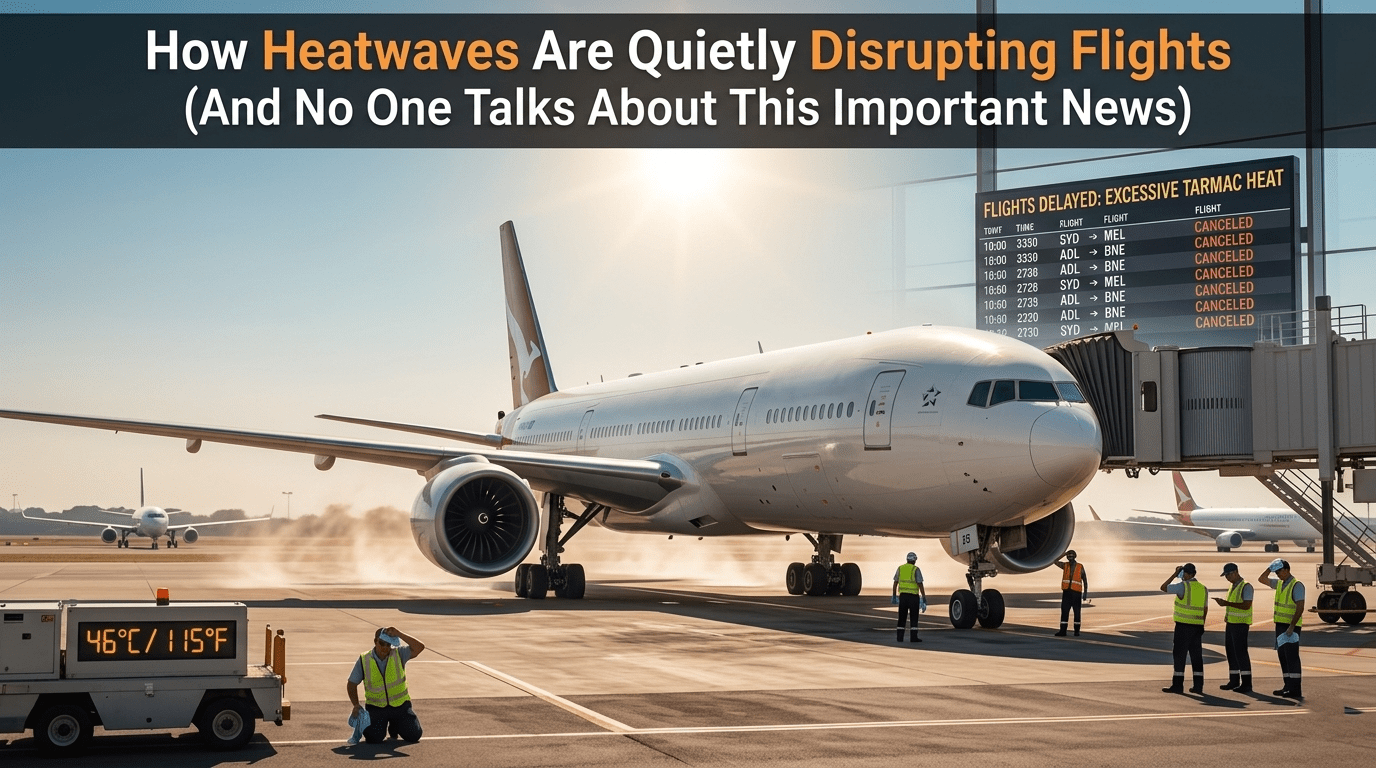
You’ve heard of flights getting canceled because of snowstorms.
Or delayed because of thunderstorms.
Makes sense. Visible chaos, dramatic skies, obvious problem.
But here’s the weird part no one tells you:
Clear skies… can mess up your flight just as badly.
No storm. No rain. No warning.
Just heatwaves.
And not the “oh it’s warm outside” kind of heat—
the kind that quietly turns airports into bottlenecks and planes into struggling machines.
Let’s break it down—because once you see it, you’ll never look at “sunny weather” the same way again.
☀️ The Problem: Heat Doesn’t Look Dangerous (But It Is)
Here’s the illusion:
- Sunny day → Good travel weather
- No clouds → Smooth flights
Right?
Not exactly.
In reality, extreme heat is one of the most underrated causes of flight disruption worldwide—and it’s getting worse.
Recent heatwaves across the U.S., Europe, and Asia have already caused:
- Flight delays
- Weight restrictions
- Ground delays
- Even full cancellations
And yet… it rarely makes headlines the way storms do.
✈️ Why Heat Messes With Planes (The Simple Version)
Let’s keep this non-physics-y.
Planes rely on air density to fly.
But when temperatures rise:
👉 Air becomes thinner
👉 Thin air = less lift
👉 Less lift = harder takeoff
That’s not a theory—that’s basic aviation reality.
In extreme heat:
- Planes need longer runways
- Engines produce less thrust
- Aircraft may need to reduce weight
Which leads to something passengers hate:
👉 Bags getting removed
👉 Seats going empty
👉 Flights delayed… or canceled entirely
As aviation experts explain, hot air reduces both lift and engine performance, making safe takeoff more difficult—especially at smaller airports or high-altitude locations.
🔥 The “Weight Problem” No One Warns You About
Here’s where things get frustrating.
If a plane can’t safely take off in hot conditions, airlines have two options:
- Delay the flight
- Make the plane lighter
Guess how they make it lighter?
Yep.
👉 Luggage gets removed
👉 Cargo gets delayed
👉 In extreme cases… passengers get bumped
This isn’t rare—it’s standard protocol.
In past heatwaves, airlines have literally had to remove passengers or baggage just to get airborne safely.
So if you’ve ever wondered:
“Why is my bag on a different flight?”
Now you know.
🛫 Tarmac Heat: The Invisible Enemy
Now let’s talk about something even worse.
Not the air…
but the ground.
Runways absorb heat like crazy.
That means:
- Air temperature: 40°C
- Tarmac temperature: 50–60°C+
At that point:
- Aircraft systems are under stress
- Ground crews need breaks
- Equipment slows down
And everything… just… drags.
Airports have even reported:
- Slower baggage handling
- Delays getting planes to gates
- Reduced turnaround speeds
Because workers literally can’t safely operate at full speed in extreme heat.
🧍♂️ The Passenger Experience (It Gets Worse)
Let’s be honest—this is where it hits you.
You’re not thinking about air density.
You’re thinking:
“Why am I sweating inside a parked plane?”
Here’s why:
- Planes rely on engines for full air conditioning
- On the ground, systems are weaker
- Extreme heat overwhelms cooling systems
So when delays happen on the tarmac:
👉 Cabins heat up
👉 Air circulation struggles
👉 Passengers feel it immediately
There have even been cases where passengers experienced heat stress and fainting during prolonged delays in extreme temperatures.
Fun, right?
🌍 This Isn’t Just One Country — It’s Global
Here’s the bigger shift.
Heatwaves are no longer “regional events.”
They’re happening everywhere:
- U.S. → Record-breaking summer temperatures
- Europe → Airports struggling during heat spikes
- India & Middle East → Tarmac temperatures delaying takeoffs
- Australia → Extreme heat affecting airport operations
And it’s all connected.
Because modern aviation isn’t local.
One overheated airport can ripple through:
👉 Flight connections
👉 Crew schedules
👉 Aircraft availability
Sound familiar?
That’s because you’ve already seen this effect with storms.
Heat is just doing the same thing—quietly.
🧠 Why No One Talks About This
Honestly?
Because heat doesn’t look dramatic.
No lightning.
No snow-covered runways.
No viral footage.
Just delays.
But the aviation industry knows this is a growing problem.
In fact, research suggests future heatwaves will increasingly disrupt air travel, affecting takeoffs and scheduling worldwide.
Translation:
This isn’t going away.
It’s becoming part of how travel works.
🧭 Smart Traveler Moves (That Actually Help)
Alright—so what do you do with this?
Here’s how to travel smarter in heatwave conditions:
1. Book Early Morning Flights
Cooler air = better conditions = fewer delays
Midday flights? Highest risk.
2. Avoid Smaller Airports
Shorter runways + heat = more restrictions
Major hubs handle heat better.
3. Expect Baggage Delays
Pack essentials in carry-on.
Assume your checked bag might not arrive with you.
4. Hydrate Like You Mean It
This sounds basic… until you’re stuck on a hot plane.
5. Track Flights in Real Time
Apps like flight trackers (from your previous blog 😉) become critical here.
✈️ The Bigger Truth About Travel in 2026
Storms disrupt travel loudly.
Heat disrupts travel quietly.
But both are now part of the same reality:
👉 Travel is becoming weather-dependent in ways it never was before.
And not just in extreme cases—
in everyday planning.
That “perfect sunny travel day”?
It might actually be the reason your flight gets delayed.
🌍 Final Thought: The New Travel Rule
You don’t just check the weather anymore.
You interpret it.
Cold → delays
Storms → cancellations
Heat → hidden disruptions
And once you understand that…
You stop being the confused passenger at the gate
…and start being the one who saw it coming.
🎯 Feeling Spontaneous Instead?
If all this planning feels like too much… flip the script.
Try something different.
Head over to our Random European Country Generator and let randomness decide your next trip. Because sometimes, the best travel decisions happen when you stop overthinking—and just go somewhere unexpected.
Leave a Reply