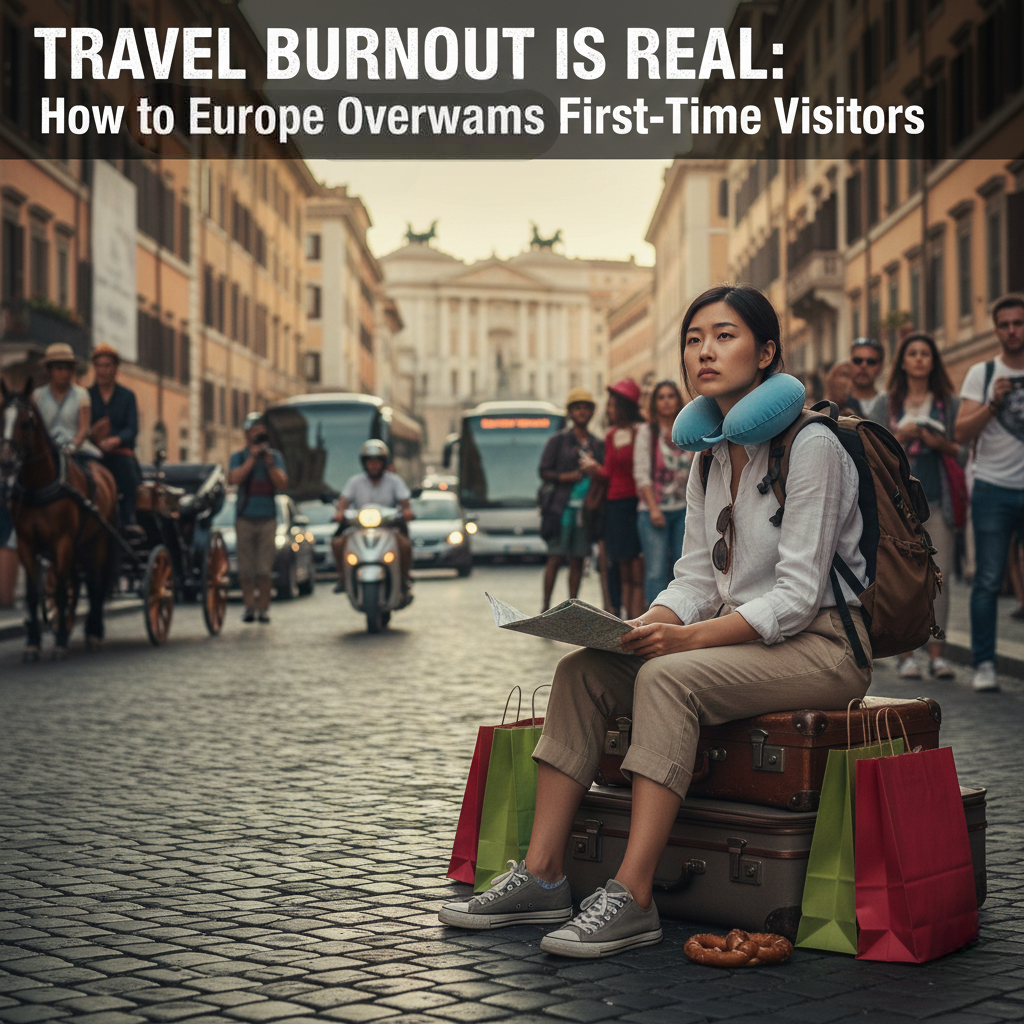
Alright, let’s talk about the thing nobody puts on their Europe itinerary spreadsheet.
Not pickpockets.
Not jet lag.
Not overpriced coffee near landmarks.
Travel burnout.
The quiet, creeping exhaustion that turns “I’m in Paris!!!” into “I just want my bed and Wi-Fi.”
It hits first-time visitors especially hard—and Europe, wonderful and chaotic as it is, is very good at causing it.
This isn’t a dramatic thinkpiece. It’s a reality check.
Because Europe doesn’t just overwhelm you with beauty—it overwhelms you with options, expectations, logistics, and pressure to optimize every second.
Let’s unpack why travel burnout is real, why Europe triggers it so often, and how to survive your first trip without needing a vacation from your vacation.
What Travel Burnout Actually Is (And What It Isn’t)
Travel burnout isn’t “being tired.”
It’s mental overload mixed with physical fatigue and decision exhaustion.
Symptoms usually include:
- Feeling numb in places you know are amazing
- Irritation over tiny inconveniences
- Guilt for not “enjoying it enough”
- Decision paralysis (“I don’t care where we eat, just choose”)
- A weird urge to scroll your phone instead of exploring
Burnout sneaks in when stimulation exceeds recovery. Europe is basically an all-you-can-eat buffet of stimulation.
Why Europe Hits First-Time Travelers the Hardest
Europe looks compact on a map. That’s the first lie.
Yes, distances are shorter than continents like North America—but culturally, mentally, and logistically, Europe is a patchwork of different systems stitched together with budget airlines and train lines.
For a first-timer, this creates friction in places you don’t expect.
Too Much History, Too Fast
Europe doesn’t do subtle.
You’re walking past buildings older than your country. Churches look like museums. Museums look like palaces. Palaces look like entire cities.
At first, it’s magical.
By day four, everything starts blending together.
Castle fatigue is real. So is church fatigue. So is “another Roman ruin” fatigue.
Your brain wasn’t built to emotionally process:
- 12 centuries in a single afternoon
- 3 UNESCO sites before lunch
- A tragic historical plaque every two blocks
Eventually, awe turns into overload. Not because the places aren’t special—but because you never stop to digest them.
The Pressure to “See Everything”
Europe travel culture quietly encourages overpacking itineraries.
Paris in 2 days
Rome in 3
Barcelona in 2
Amsterdam in 2
Day trip here
Night train there
It looks efficient. It feels productive. It absolutely drains people.
First-time travelers often feel:
“If I don’t see it now, I’ll regret it forever.”
So they rush. They stack cities. They live out of backpacks. They wake up early, sleep late, and never pause.
Burnout loves tight schedules.
Constant Movement Is Exhausting (Even If It’s Fun)
Europe’s transportation is amazing.
It’s also mentally taxing when you’re new.
Trains, metros, trams, buses, ferries, rideshares—all with:
- Different ticket systems
- Different validation rules
- Different languages
- Different social norms
Every move requires thinking.
Every transfer demands attention.
Even “easy” travel drains energy when it’s nonstop.
Your body moves faster than your brain can recover.
Cultural Whiplash Is a Thing
Europe is not one culture. It’s dozens.
What’s polite in one country is rude in another.
What’s normal in one city feels cold in the next.
Examples first-timers don’t expect:
- Servers don’t hover or rush you
- Smiling at strangers doesn’t always get smiles back
- Customer service norms vary wildly
- Directness can feel harsh if you’re not used to it
This constant recalibration is subtle—but exhausting.
You’re always adjusting how you speak, behave, tip, queue, or ask for help.
That mental load adds up.
Language Fatigue Is Real Too
Even if “everyone speaks English,” your brain is still decoding:
- Signs
- Announcements
- Menus
- Place names
- Accents
Your brain never fully relaxes into autopilot.
By the end of the day, silence feels like luxury.
Instagram Expectations vs Reality
Europe is marketed as cinematic perfection.
What’s not shown:
- Crowds
- Lines
- Heat
- Rain
- Noise
- Construction
- Over-tourism
First-time travelers often feel disappointed—not because Europe disappoints, but because expectations were unrealistic.
When reality doesn’t match the highlight reel, burnout accelerates.
Decision Fatigue: The Invisible Drain
Every day in Europe demands choices:
- What to see
- What to skip
- Where to eat
- How to get there
- Whether it’s “worth it”
Multiply that by 10–14 days and your brain quietly taps out.
Burnout doesn’t announce itself. It just whispers:
“I don’t care anymore.”
Why Burnout Feels Worse When You Think You “Should Be Grateful”
Here’s the cruel twist.
People feel guilty for being overwhelmed in Europe.
“This is a dream trip.”
“People would kill to be here.”
“I shouldn’t complain.”
So instead of resting, they push harder.
Burnout thrives on guilt.
Signs You’re Approaching Travel Burnout in Europe
Watch for these early warnings:
- You stop taking photos—not intentionally, but from disinterest
- You skip meals because choosing feels annoying
- You get irritated at small delays
- You start counting days instead of experiences
- You fantasize about your bed back home
None of these mean your trip is failing.
They mean your pace is.
How to Prevent Burnout (Without Missing Out)
This is the part people don’t talk about enough.
Fewer Cities, Deeper Stays
Two cities done well beat five rushed ones every time.
Staying longer lets:
- Your body settle
- Your brain relax
- Familiarity replace constant novelty
Comfort is not laziness. It’s sustainability.
Schedule “Nothing” on Purpose
Not “free time.”
Actual nothing.
No sights. No plans. No optimization.
Coffee. Wandering. Sitting. Observing.
Europe shines when you stop trying to conquer it.
Break the Museum Marathon
Alternate heavy days with light ones.
History days → food days
Walking days → sitting days
Landmark days → neighborhood days
Your brain needs contrast.
Stop Treating Travel Like a Checklist
Seeing “the best” doesn’t mean seeing everything.
Missing things is inevitable. Burning out is optional.
Accept That Europe Isn’t a Monolith
Every country has a different rhythm.
Let yourself adjust instead of forcing the same travel style everywhere.
The Unexpected Upside of Burnout Awareness
Here’s the good news.
Once you understand burnout, Europe becomes better—not worse.
You start noticing:
- Local rhythms
- Quiet streets
- Ordinary beauty
- Human moments
The trip stops being a performance and becomes an experience.
Final Thoughts: Europe Isn’t Too Much — We Just Ask Too Much of Ourselves
Europe overwhelms first-time travelers not because it’s intense, but because we try to consume it instead of inhabit it.
Burnout isn’t failure.
It’s feedback.
Slow down. Skip something. Sit longer. Breathe deeper.
Europe will still be there tomorrow.
And you’ll actually remember it.
If choosing where to slow down feels impossible, sometimes randomness beats overthinking. Our Random European Country Generator is built for moments like that—when decision fatigue kicks in and you just want the journey to choose you.
Because sometimes, the best way to avoid burnout… is to stop planning like a machine and travel like a human.
Research from Euronews Travel shows that many young Europeans now treat travel as a form of self‑care that helps reduce stress and break routine. A survey of over 5,000 travellers found that 88% felt travel boosted happiness and helped them disconnect from daily burnout triggers — underscoring how travel can both relieve and cause emotional fatigue when done too fast.
Leave a Reply