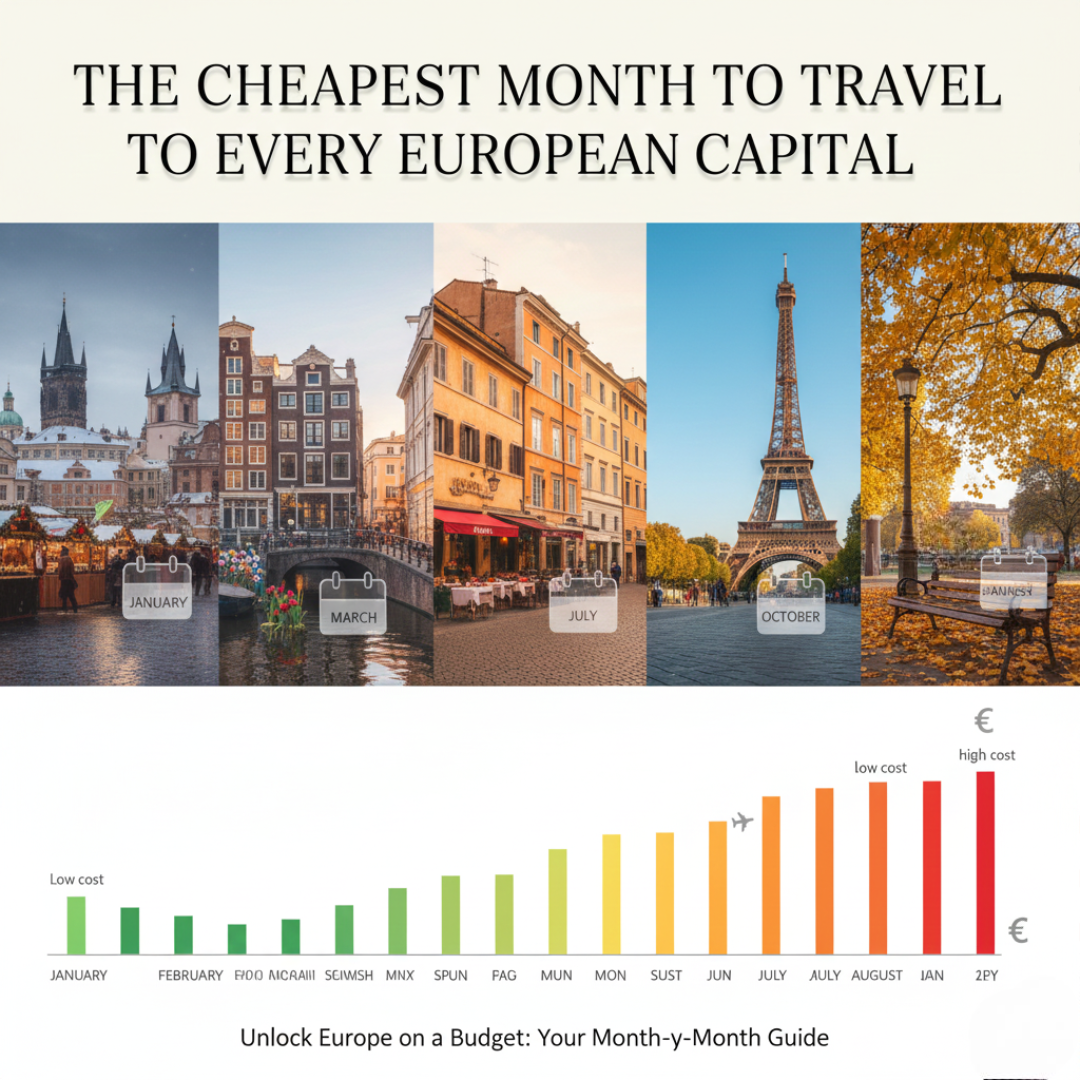
(And the One You’ll Regret Booking)
Everyone wants the same magical formula: perfect weather, zero crowds, cheap flights, cheap hotels.
That month does not exist. It never has. It’s a unicorn wearing a scarf.
What does exist is something better: predictable seasonal patterns. Once you understand those, Europe stops feeling expensive and starts feeling… negotiable.
This isn’t a romantic travel piece. This is the “save money, skip chaos, still have fun” version for European Capital.
First, the Big Lie About “Cheap Europe”
People say things like:
- “Europe is cheapest in winter”
- “Just avoid summer”
- “Shoulder season is best for everything”
All half-true. And half-truths are how wallets get hurt.
Prices in Europe are driven by four forces:
- School holidays
- Weather tolerability (not beauty, tolerability)
- Festival density
- Local tourism dependence
Capitals behave differently than beach towns. Political cities behave differently than party cities. That’s why Rome and Stockholm don’t peak the same way.
So let’s break it down properly.
Western Europe
London, UK
Cheapest: January
Avoid: July
January London is cold, grey, and oddly peaceful. Flights drop hard after New Year’s, hotels run discounts, and museums are warm and free.
July is peak tourist chaos: school holidays + festivals + mild weather = premium pricing everywhere.
Paris, France
Cheapest: February
Avoid: August
February is quiet, romantic without trying, and much cheaper than you’d expect.
August is deceptively expensive despite locals leaving. Hotels stay pricey, services are limited, and crowds still show up.
Berlin, Germany
Cheapest: January
Avoid: September
January Berlin is bleak but brutally affordable. Flights and hotels bottom out.
September spikes due to festivals, conferences, and surprisingly good weather.
Amsterdam, Netherlands
Cheapest: January
Avoid: April
January is cold and calm. Hotels finally breathe.
April is tulip season + King’s Day. Prices go feral.
Brussels, Belgium
Cheapest: February
Avoid: July
February is sleepy and cheap.
July brings EU travel, festivals, and inflated hotel rates.
Southern Europe
Rome, Italy
Cheapest: January
Avoid: June
January Rome is cool, uncrowded, and magical in a “locals only” way.
June starts the heat + cruise ship invasion. Prices follow.
Madrid, Spain
Cheapest: February
Avoid: May
February is mild and affordable.
May explodes with festivals, perfect weather, and tourists who planned “smartly” at the same time.
Lisbon, Portugal
Cheapest: January
Avoid: August
January is quiet, affordable, and still sunny-ish.
August is peak European vacation season. Prices spike hard.
Athens, Greece
Cheapest: February
Avoid: July
February is cool, cheap, and crowd-free.
July is heat, cruise ships, and sunburn economics.
Northern Europe (where timing REALLY matters)
Stockholm, Sweden
Cheapest: November
Avoid: June
November is dark but deeply discounted.
June has long daylight, festivals, and absurd prices.
Oslo, Norway
Cheapest: January
Avoid: July
January is cold, yes. Also half-price flights.
July is summer holidays + nature tourism = wallet pain.
Copenhagen, Denmark
Cheapest: January
Avoid: June
January brings deals everywhere.
June is peak hygge fantasy pricing.
Helsinki, Finland
Cheapest: November
Avoid: July
November is the cheapest month by far.
July is festivals, light-filled nights, and premium everything.
Central & Eastern Europe (the real MVPs)
Prague, Czech Republic
Cheapest: January
Avoid: August
January is icy but affordable.
August brings tour buses and inflated hotel rates.
Vienna, Austria
Cheapest: February
Avoid: December
February is calm and elegant without the prices.
December Christmas markets drive rates way up.
Budapest, Hungary
Cheapest: January
Avoid: August
January is one of Europe’s best-value capitals.
August = festivals + heat + higher prices.
Warsaw, Poland
Cheapest: February
Avoid: July
February is budget-friendly and quiet.
July is summer travel season and prices climb.
Bratislava, Slovakia
Cheapest: January
Avoid: June
January is extremely affordable.
June sees spillover tourism from Vienna.
The Baltics & Balkans
Tallinn, Estonia
Cheapest: November
Avoid: July
November is shockingly cheap.
July is cruise season pricing madness.
Riga, Latvia
Cheapest: February
Avoid: August
February is cold but calm.
August brings festivals and inflated rates.
Vilnius, Lithuania
Cheapest: January
Avoid: July
January offers some of the best hotel deals in Europe.
July is summer peak.
Bucharest, Romania
Cheapest: February
Avoid: September
February stays affordable and underrated.
September brings conferences and price jumps.
Sofia, Bulgaria
Cheapest: January
Avoid: June
January is quiet and cheap.
June brings festivals and warmer tourism demand.
The Pattern You’re Supposed to Notice
Three truths emerge:
- January–February are the cheapest months for most capitals
- July–August are almost always the worst value
- “Shoulder season” only works if everyone else doesn’t choose it too
The cheapest month is often uncomfortable, not unbearable. The most expensive month is comfortable and crowded.
When Cheap Isn’t Worth It
Cheap months come with trade-offs:
- Short daylight hours in the north
- Cold weather
- Occasional attraction closures
- Fewer festivals
But here’s the secret:
Cities don’t stop being cities in winter. Cafés still exist. Museums still work. Trains still run. And prices stop yelling at you.
The Smart Booking Rule (Use This)
If you want:
- Lowest prices: Late January – February
- Balance: March or November
- Avoid regret: Skip July and August unless beaches are involved
Instagram lies. Seasonality does not.
Final Reality Check
Europe isn’t expensive by default. It’s expensive when everyone goes at the same time.
If you’re flexible, curious, and slightly rebellious about timing, Europe becomes dramatically cheaper without losing its soul.
Travel isn’t about perfect weather.
It’s about good timing and fewer people breathing near your face.
And once you learn that, you stop overpaying forever.
If decision fatigue is creeping in, letting randomness choose can be oddly freeing. Our random European country generator exists for exactly that moment—when planning becomes heavier than excitement.
Leave a Reply