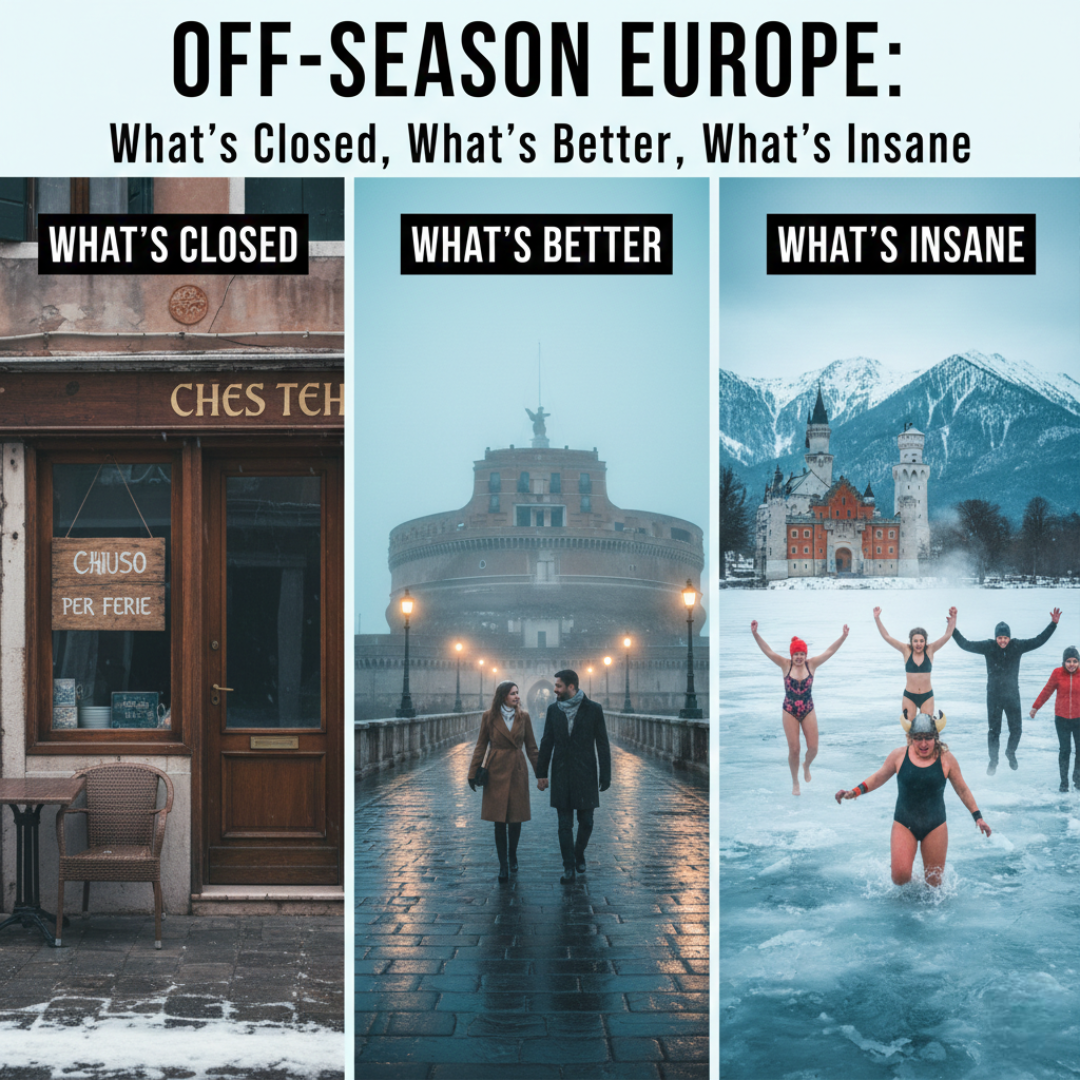
Travel blogs love to whisper about off-season Europe like it’s a secret menu item. Cheaper flights. Empty streets. Locals smiling knowingly as you pass by with a croissant and a sense of superiority.
Reality is messier. Some things absolutely improve. Some things quietly disappear. And some attractions? Turns out they were never that good to begin with.
Let’s break it down without romantic fog.
First, What Counts as “Off-Season” in Europe?
Roughly speaking:
- November to March (excluding Christmas and New Year)
- Shoulder months like late October and early April sit in the gray zone
Northern Europe goes into hibernation earlier. Southern Europe stays half-awake longer. Europe is not a single mood—it’s a patchwork of weather, habits, and cultural patience for tourists.
What’s Closed (And This Is Where People Get Mad)
This is the part Instagram captions conveniently ignore.
1. Seasonal Attractions Go Dark
Boat tours, scenic mountain routes, island ferries, lake cruises—many of them shut down or run limited schedules.
That dreamy Amalfi Coast boat hop? Not happening in January.
Swiss alpine cable cars? Some run, some vanish.
Greek islands? Many feel like movie sets after the actors left.
If an experience relies on sunshine, crowds, or temporary staff, it’s the first to disappear.
2. Shorter Opening Hours Everywhere
Museums still exist, but they behave differently.
You’ll see:
- Museums closing at 4 or 5 PM
- Fewer late-night openings
- Some smaller museums closed multiple days per week
Cities slow down in winter. They don’t apologize for it.
3. Restaurants Take “Personal Time”
In off-season towns, restaurants rotate closures like a quiet conspiracy.
Monday? Closed.
Tuesday lunch? Closed.
January? “Back in spring.”
Tourist-only eateries vanish. Local places remain—but they don’t care if you flew 5,000 miles to eat there.
4. Coastal & Resort Towns Half-Disappear
Beach towns without beaches are… existentially confused.
Southern Spain, parts of Italy, Greek coastal towns—many become places where:
- Shops close
- Streets empty
- Only retirees and cats remain
Some travelers love this. Others feel like they accidentally arrived after the apocalypse.
What’s Actually Better (And This Is the Real Value)
Now for the part people quietly fall in love with.
1. Prices Stop Yelling at You
Flights drop. Hotels stop playing games. Apartments cost less than a single museum ticket did in August.
You’re not just saving money—you’re buying flexibility:
- Upgrading hotels suddenly makes sense
- Staying longer becomes affordable
- Last-minute decisions don’t hurt
Off-season Europe rewards travelers who hate financial pressure.
2. Cities Belong to Humans Again
Rome without shoulder-to-shoulder foot traffic feels illegal. Paris without lines that require emotional preparation feels fake.
You notice:
- Actual architecture
- Sound of footsteps
- Locals living instead of dodging tourists
Tourist cities stop performing and start existing.
3. Museums Become Enjoyable
This is a big one.
Off-season museums mean:
- No elbow combat
- No timed-entry anxiety
- No security guards begging people to move
You can stand in front of a painting and think instead of calculating how long before someone bumps you.
4. Public Transport Improves (Emotionally)
Trains run. Buses run. But they’re not stuffed with backpacks, strollers, and emotional breakdowns.
You sit. You breathe. You arrive calm.
Travel fatigue drops dramatically when logistics stop fighting you.
5. Food Gets Better (Quietly)
Here’s the secret: when tourists disappear, bad restaurants starve.
Local places remain. Menus simplify. Ingredients improve. Staff relax.
You stop eating “tourist food” because there’s no one left to sell it to.
What’s Overrated (And Always Was)
This is where off-season travel exposes illusions.
1. “Must-See” Landmarks
If an attraction loses all appeal without crowds and sunshine, it was never the attraction—it was the spectacle.
You’ll realize:
- Some landmarks are five-minute experiences
- Some viewpoints exist mostly for photos
- Some “iconic” places feel empty without chaos
And that’s okay. You didn’t fail travel. Marketing failed honesty.
2. Perfect Weather Fantasies
Europe in winter isn’t ugly. It’s moody.
Gray skies. Mist. Early sunsets.
If you need golden light for happiness, off-season will test you. But if you enjoy atmosphere, cafés, and cities that feel introspective, winter Europe has depth summer never touches.
3. Hyper-Planned Itineraries
Off-season punishes rigid planning.
Things close unexpectedly. Hours change. Weather interrupts.
Travelers who thrive off-season:
- Wander
- Adjust
- Accept detours
If your joy comes from ticking boxes, summer may suit you better.
Region-by-Region Reality Check
Because Europe doesn’t behave uniformly.
Southern Europe (Italy, Spain, Greece, Portugal)
Pros
- Mild winters
- Lower prices
- Still lively in major cities
Cons
- Islands slow way down
- Coastal towns may feel abandoned
- Some attractions fully close
Best for cities. Not great for beach dreams.
Central Europe (France, Germany, Austria, Switzerland)
Pros
- Magical winter atmosphere
- Christmas markets (early winter)
- Efficient infrastructure
Cons
- Cold snaps
- Short daylight hours
- Mountain access varies
Perfect for museums, cafés, and slow travel.
Northern Europe (Scandinavia, Baltics)
Pros
- Snowy beauty
- Fewer tourists than ever
- Unique winter culture
Cons
- Darkness (a lot of it)
- Some ferries reduce schedules
- Outdoor activities weather-dependent
Go prepared mentally, not just physically.
Eastern Europe
Pros
- Insanely affordable
- Less seasonal closure
- Authentic daily life
Cons
- Weather can be brutal
- Smaller towns very quiet
- Infrastructure varies
Underrated off-season winner for patient travelers.
Who Off-Season Europe Is Perfect For
This matters more than dates.
Off-season travel works best if you:
- Hate crowds
- Love walking cities
- Enjoy museums and cafés
- Prefer atmosphere over activity
- Value flexibility
It struggles if you:
- Need beaches
- Want nightlife every night
- Rely on guided tours
- Expect everything to stay open late
Off-season doesn’t meet expectations—it rewrites them.
The Emotional Difference No One Talks About
Summer Europe feels like a performance.
Off-season Europe feels like a conversation.
You’re not one of millions passing through. You’re someone temporarily living there.
You notice routines. You hear languages more clearly. You feel cities breathe.
That’s not better for everyone—but for some people, it’s addictive.
Final Verdict: Is Off-Season Europe Worth It?
Yes—if you travel for experience, not validation.
Off-season Europe strips travel down to essentials:
- Place
- People
- Time
It removes the noise and leaves the structure. Some travelers miss the noise. Others finally hear the city.
Neither is wrong.
But now you know the deal—before the plane lands.
If you’re embracing off-season Europe but still can’t decide where to go, let chance do the heavy lifting. Our Random European Country Generator picks a destination for you in one click — perfect for spontaneous trips, budget travel, or breaking out of your usual Italy–France–Spain loop. Sometimes the best journeys start with a little randomness.
Leave a Reply