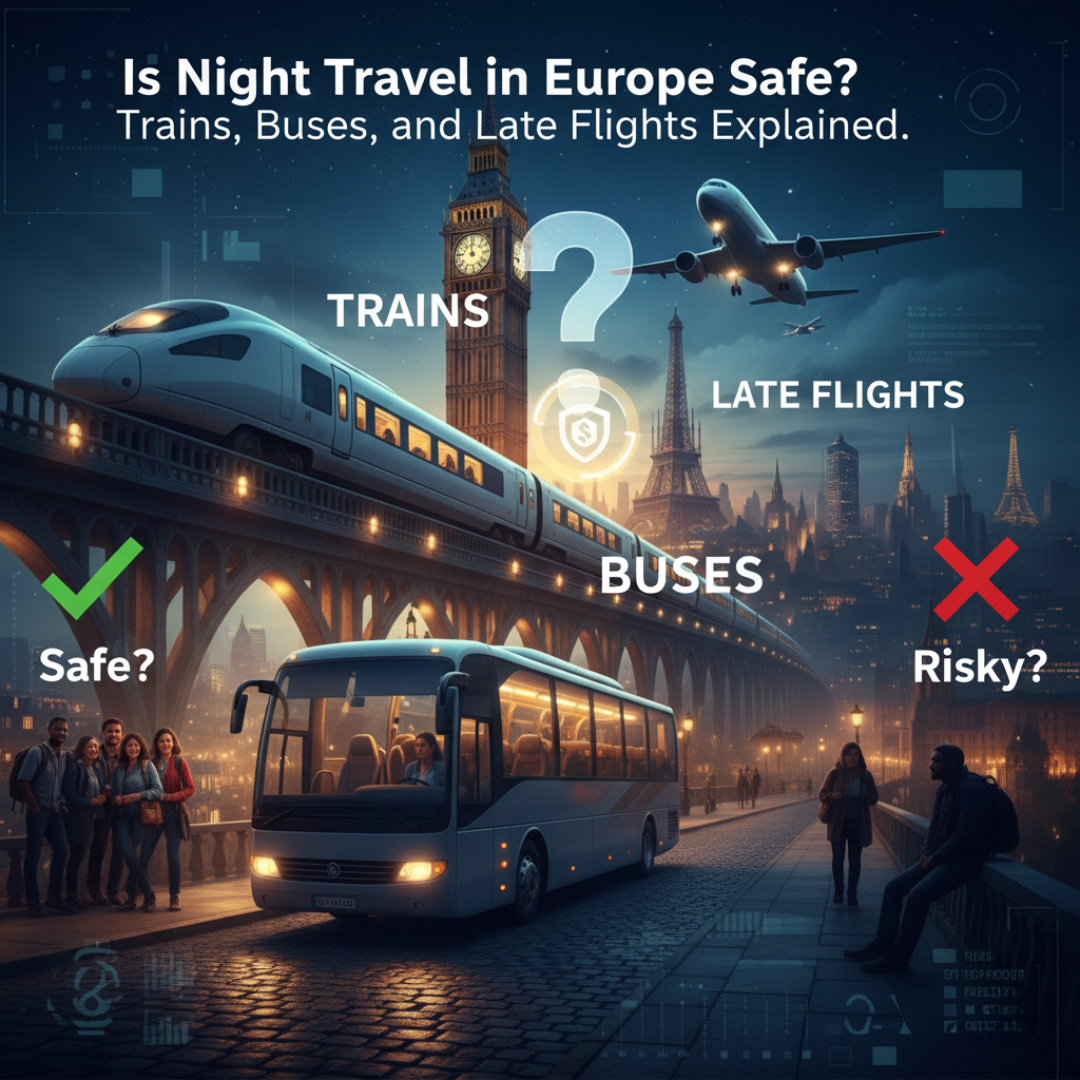
Alright, let’s dim the lights, grab a seat by the window, and talk about the thing everyone worries about but rarely explains properly.
Night travel in Europe.
Trains at midnight. Buses at 2 a.m. Flights that land when your brain has already clocked out.
Is it dangerous?
Is it smart?
Or is it just dramatically over-feared?
Short answer: it’s mostly safe, occasionally annoying, and very context-dependent.
Long answer: buckle up—this is where the nuance lives.
Why Night Travel Feels Scarier Than It Usually Is
Humans are terrible risk calculators at night. Darkness + unfamiliar place + tired brain = instant horror movie soundtrack.
Your instincts scream:
“Strangers.”
“Closed stations.”
“Crime documentaries.”
Reality usually says:
“Other travelers.”
“Security cameras.”
“A bored station cat.”
Europe isn’t a monolith, though. A 11:30 p.m. train in Switzerland is not the same experience as a 1:15 a.m. bus in a half-lit industrial zone outside a major city. Safety here is less about the clock and more about infrastructure, design, and social norms.
So let’s break this down properly—by transport type.
Night Trains: The Safest Option (And Often the Best One)
If night travel had a valedictorian, trains would be giving the speech.
Why night trains are generally safe
European trains—especially intercity and international ones—are built for nighttime use. That means:
- Staff on board, even late
- Controlled access points
- CCTV in carriages and platforms
- Other passengers (you’re rarely alone)
Most night trains are filled with:
Backpackers saving on hotels, business travelers, students, and people who’ve done this a hundred times.
That matters. Crowds—even sleepy ones—reduce risk dramatically.
Sleeper trains vs regular night trains
Sleeper trains (ÖBB Nightjet, EuroNight, etc.) are extremely safe. You’re in a compartment, often with a lock, sometimes with a conductor checking tickets multiple times overnight.
Regular night trains are still fine, but choose:
- Middle carriages
- Seats near other passengers
- Areas close to staff cabins
Avoid empty end cars unless you enjoy suspense.
Where night trains feel safest
- Switzerland (borderline boring levels of safety)
- Germany
- Austria
- Netherlands
- Scandinavia
Still safe but more “keep your awareness on”:
- Italy
- Spain
- France (especially suburban lines late at night)
Real risks on night trains
Pickpocketing while you sleep. That’s the big one.
If your bag is:
- Wrapped around your leg
- Under your seat
- Zipped and clipped
You’re already ahead of 90% of travelers.
Violent crime on trains is rare. Petty theft is the main character here.
Night Buses: The Most Inconsistent Option
Night buses are the wild card. Sometimes perfectly fine. Sometimes… a vibe you didn’t ask for.
Why buses feel sketchier
- Fewer passengers
- Fewer staff
- Stops in poorly lit areas
- Longer travel times = fatigue
A bus at 1 a.m. is more dependent on where and who than when.
Long-distance buses (FlixBus, BlaBlaBus, etc.)
These are generally safe, even at night.
Pros:
- Assigned seating
- Luggage storage
- Other travelers
- GPS-tracked vehicles
Cons:
- Stops at rest areas
- Sometimes dropped at inconvenient terminals
- Less oversight inside the bus
Sit near the front. Drivers are unofficial bouncers.
Local night buses
This is where caution increases—not panic, just awareness.
In major cities, night buses are common and mostly safe:
- London
- Berlin
- Paris
- Barcelona
They’re often used by:
- Night shift workers
- Students
- Party crowds
Which means noise, not necessarily danger.
Smaller cities or suburban routes late at night can feel emptier and less supervised. Still not inherently unsafe—but less forgiving if something goes sideways.
The real risk with night buses
The arrival, not the ride.
Being dropped at a poorly connected bus station at 3 a.m. with no taxis and Google Maps gaslighting you—that’s the stress point.
Late-Night Flights: Safer Than They Feel, Worse Than They Should Be
Airports are safe. Full stop.
The issue isn’t the flight—it’s everything around it.
Airports at night
Pros:
- Heavy security
- Cameras everywhere
- Staff present
- Clear procedures
Cons:
- Limited transport options
- Fewer shops and services
- Long waits if something goes wrong
Landing at midnight isn’t dangerous. Landing at midnight and realizing the last train left 10 minutes ago? That’s where people get stuck.
Airport transfers after midnight
This varies massively by city.
Excellent late-night connections:
- London
- Paris
- Madrid
- Amsterdam
- Vienna
More limited or painful:
- Rome
- Athens
- Smaller regional airports
Sometimes a €40 taxi is the safe and sane choice. Budget travel logic breaks down at 1 a.m.
Sleeping in airports
Legal in many European airports, tolerated in most, comfortable in almost none.
Safe? Usually yes.
Fun? Absolutely not.
Gender, Solo Travel, and Night Movement
Let’s address the unspoken part.
Solo travelers
Solo travel at night in Europe is common. You won’t stand out just because you’re alone. Confidence and normal behavior go a long way.
Solo female travelers
Europe is one of the safer regions globally for women traveling alone—even at night—but context matters.
Smart adjustments:
- Avoid empty platforms
- Sit near other women or families
- Don’t advertise confusion
- Trust discomfort signals, not paranoia
Most incidents reported by women are about harassment, not assault—and even those are statistically low on trains and planes.
The biggest safety multiplier
Act like you know where you’re going—even if you don’t.
People who look lost attract attention. People who look mildly annoyed and purposeful are invisible.
Cities vs Countryside: An Important Distinction
Big cities:
- More lighting
- More transport
- More people
- More cameras
Small towns:
- Quiet
- Dark
- Limited services
- Still safe, but less forgiving
Ironically, cities feel scarier but are usually safer at night than empty rural stations.
What Actually Causes Problems at Night
Let’s be brutally honest.
Most night travel “incidents” involve:
- Alcohol
- Fatigue
- Poor planning
- Overconfidence
Not random attacks.
Missed connections, dead phones, and bad timing cause far more stress than crime ever does.
Practical Rules That Actually Matter
This isn’t paranoia—it’s basic competence.
- Keep your phone charged
- Download offline maps
- Know how you’re leaving the station or airport
- Carry valuables on your body, not your bag
- Avoid empty corners, not entire cities
- Trust your instincts without letting them hijack logic
Notice what’s missing? No fear-based nonsense. No “never travel at night” garbage.
So… Is Night Travel in Europe Safe?
Yes.
But not automatically.
Night trains are excellent.
Night flights are fine if planned properly.
Night buses are okay with awareness.
Europe’s infrastructure is designed for movement—not curfews. Millions of people commute, travel, and live their lives after dark every single day.
The danger isn’t the night.
It’s assuming night changes the rules completely.
It doesn’t.
Travel smart, not scared.
The moon isn’t plotting against you—it’s just bad at customer service.
If you’re still undecided after all that planning and safety-checking, sometimes the easiest move is letting fate choose. Our Random European Country Generator instantly picks a country for you, no overthinking required — perfect for spontaneous trips, late-night curiosity, or when every option somehow feels wrong. Try it out and see where Europe sends you next.
Leave a Reply