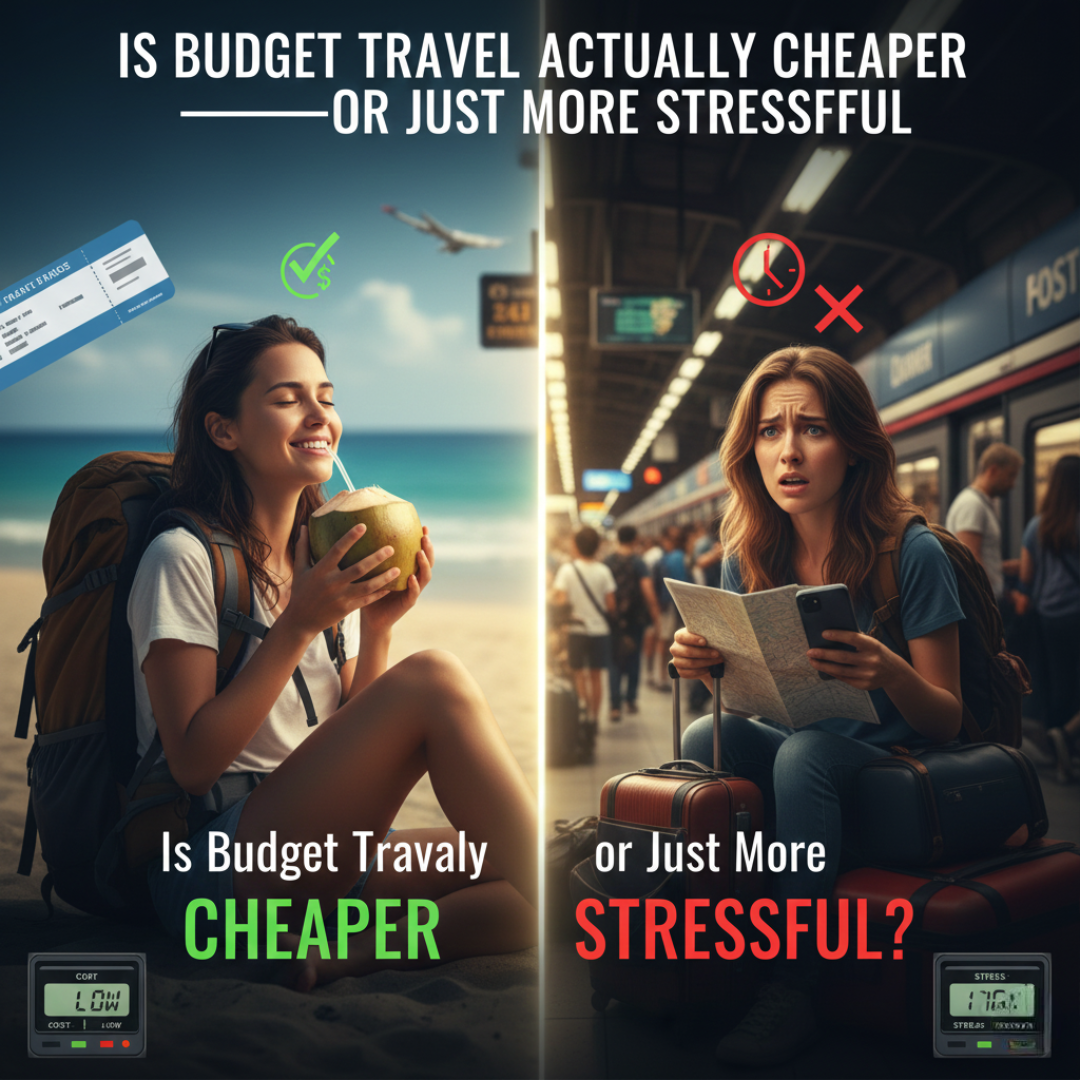
Budget travel is marketed like a life hack.
“See the world for pennies!”
“Travel smarter, not richer!”
“Only tourists overpay!”
And sure, sometimes that’s true.
But other times? Budget travel feels less like freedom and more like a unpaid internship in logistics, sleep deprivation, and low-grade anxiety.
So let’s stop romanticizing it for a moment and ask the uncomfortable question most travel blogs avoid:
Is budget travel actually cheaper… or are you just paying in stress, time, and exhaustion instead of money?
Because spoiler: money isn’t the only currency you spend when you travel.
The Myth of “Cheap” Travel
Here’s the core illusion behind budget travel advice:
It counts only what’s visible.
Flight price? Visible.
Hostel price? Visible.
Bus ticket? Visible.
What doesn’t get counted:
- Time lost
- Energy drained
- Bad sleep
- Decision fatigue
- Stress spending
- Missed experiences
- Recovery days after the trip
Budget travel math usually stops at the checkout page.
Real travel costs don’t.
Flights: Where Budget Dreams Go to Die
Let’s start with flights, because this is where most people think they “won.”
The €20 Flight That Isn’t €20
You find a €20 flight and feel like a genius.
Then reality shows up with a clipboard.
- Carry-on bag: €30
- Seat selection: €10
- Priority boarding: €8
- Airport transfer (because it’s 90 minutes away): €25
Suddenly your “cheap” flight costs €93.
And that’s before you factor in:
- A 5:30 AM departure
- A midnight arrival
- Or a six-hour layover in an airport that smells like despair and fast food
Cheap flights often save money by stealing time.
If a flight eats an entire day of your trip, that day has a cost — even if no one puts a price tag on it.
The Hidden Cost of Bad Timing
Budget airlines love:
- Early mornings
- Late nights
- Weird weekdays
That means:
- Extra nights booked just to catch a flight
- Taxis because public transport isn’t running
- Lost sleep before day one even starts
If your vacation begins with exhaustion, you’re already spending future money on survival: coffee, taxis, comfort food, “screw it” purchases.
Accommodation: Cheap Beds, Expensive Consequences
Hostels: The Truth Nobody Wants to Admit
Hostels are either:
- Incredible
- Or character-building in the worst way
Yes, they’re cheap.
Yes, they’re social.
Yes, they can be fun.
They can also be:
- Loud
- Crowded
- Inconsistent
- Full of someone repacking their bag at 3 AM like it’s an Olympic sport
Bad sleep isn’t just uncomfortable — it changes how you travel.
You walk less.
You think less clearly.
You get irritated faster.
You spend more money to compensate.
A €25 bed that ruins your sleep can easily trigger €40–€60 in extra spending the next day.
Location Is the Silent Budget Killer
Budget accommodation often sits:
- Far from city centers
- In poorly connected neighborhoods
- In “up-and-coming” areas that aren’t actually up yet
What looks cheap on paper becomes expensive in practice:
- Daily transport costs
- Extra time commuting
- Fewer spontaneous experiences
A €120 hotel in the center can be cheaper than a €60 room an hour away once you factor in transport, time, and energy.
Location isn’t a luxury. It’s logistics.
Transport: When Cheap Becomes Complicated
Budget travel loves public transport.
Public transport is great — until it isn’t.
Multiple buses.
Multiple ticket types.
Different validation rules.
Language barriers.
Each extra step increases:
- Confusion
- Mistakes
- Stress
- The chance of missing something important
Miss one connection and suddenly:
- You’re late
- You’re panicking
- You’re paying for a taxi anyway
Convenience costs money.
Inconvenience costs attention.
And attention is limited.
Food: Eating Cheap Isn’t Always Eating Well
“Just eat street food.”
Fantastic advice — when:
- You know where to go
- You have energy
- You’re not rushing
- Things are open
Reality is messier.
When you’re tired, lost, or hungry now, budget eating often becomes:
- Random snacks
- Overpriced convenience food
- Meals that don’t really count as meals
Which leads to:
- Eating more later
- Feeling worse
- Spending more anyway
Cheap food works best when you’re rested and patient — two things budget travel often takes away.
Experiences: The Cost of Doing Everything the Hard Way
Budget travel often avoids paid experiences on principle.
No tours.
No guides.
No shortcuts.
Sometimes that’s great.
Other times it means:
- You spend hours figuring things out
- You miss context
- You see less than you planned
A €25 guided tour can save:
- Three hours of wandering
- Mental energy
- Decision fatigue
Decision fatigue is expensive.
When your brain is tired, you overspend later just to stop thinking.
Stress Is a Currency (We Just Pretend It Isn’t)
Here’s the part most travel advice avoids.
Budget travel demands constant micro-decisions:
- Is this bus right?
- Is this neighborhood safe?
- Is this price fair?
- Should I wait or book now?
Your brain never rests.
And when your brain is overloaded:
- You make worse choices
- You get irritable
- You stop enjoying the place
At that point, the trip stops feeling cheap — it just feels heavy.
When Budget Travel Actually Works
Let’s be fair. Budget travel isn’t a scam.
It works brilliantly when:
- You have time
- You’re flexible
- You enjoy planning
- You’re okay with discomfort
- You’re traveling slowly
Backpackers.
Students.
Digital nomads.
Long-term travelers.
If time is abundant and pressure is low, budget travel shines.
Short trips, tight schedules, limited energy?
That’s where it starts to fall apart.
The Middle Ground Most People Miss
The smartest travelers aren’t extreme budget travelers or luxury travelers.
They’re selectively cheap.
They:
- Save on flights but pay for location
- Use public transport but splurge on sleep
- Skip fancy meals but pay for meaningful experiences
- Choose convenience when it protects their energy
This isn’t about spending more.
It’s about spending intentionally.
Ask Better Questions, Get Better Trips
The real question isn’t:
“Is this cheaper?”
It’s:
“Is this worth the trade-off?”
If saving €30 costs:
- Half a day
- Your mood
- Your ability to enjoy the place
That €30 wasn’t saved — it was borrowed from your future enjoyment.
Final Verdict: Cheap vs Costly
Budget travel can be cheaper.
But very often, it just moves the cost from your wallet to your nervous system.
The best trips aren’t the cheapest or the most expensive.
They’re the ones where money, comfort, time, and energy are balanced.
Travel shouldn’t feel like a constant problem-solving exercise.
If it does, you didn’t hack the system — you just turned your vacation into work.
And that’s the part most “ultimate budget travel guides” politely forget to mention.
If decision fatigue is creeping in, letting randomness choose can be oddly freeing. Our random European country generator exists for exactly that moment—when planning becomes heavier than excitement.
Leave a Reply