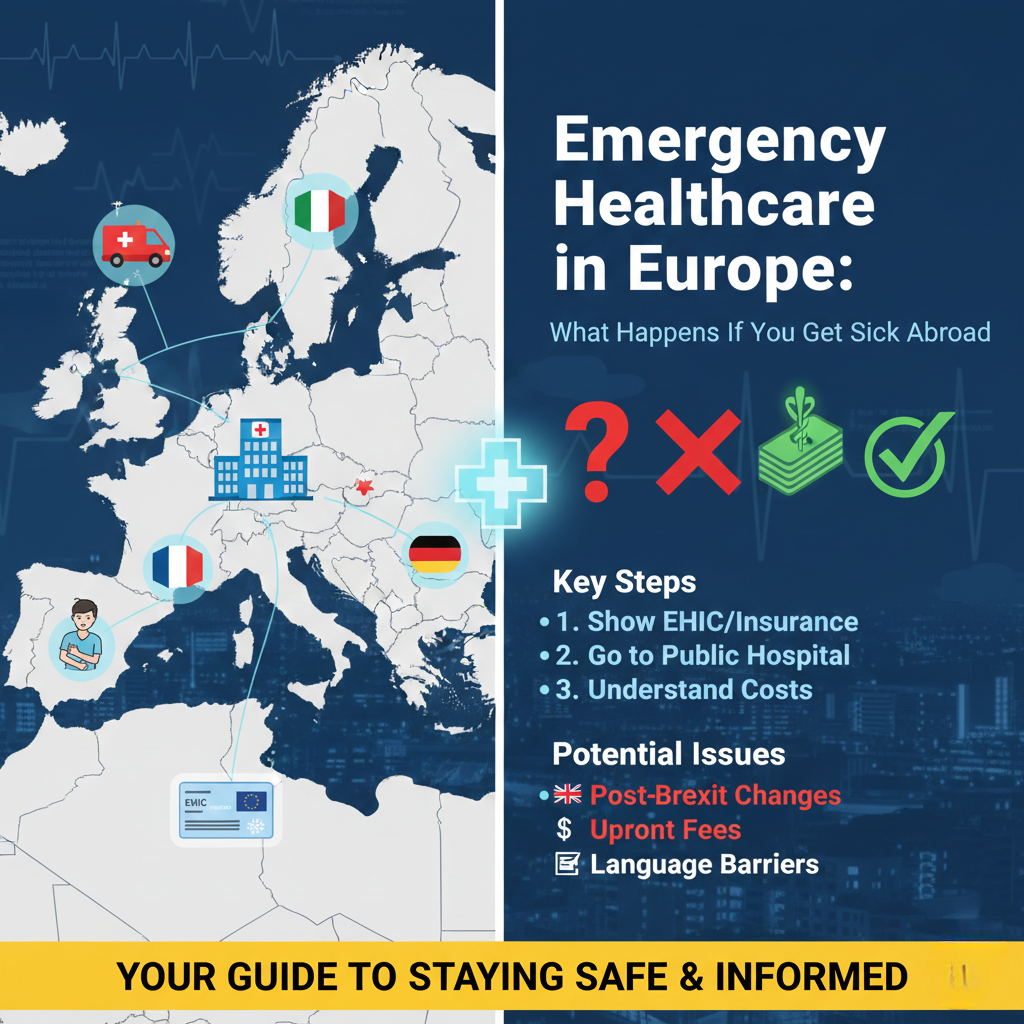
Travel is exhilarating. The cobblestone streets of Rome, the fjords of Norway, the nightlife in Berlin — all incredible experiences. But as much as we love to plan, no one plans to get sick abroad.
What happens if you wake up with a fever in Florence, break your ankle skiing in the Alps, or suddenly realize you’re allergic to every cheese in Switzerland? Europe has emergency healthcare systems that are often efficient, but the rules, costs, and processes vary wildly from country to country. Knowing what to expect isn’t just smart — it can save you money, stress, and sometimes even your trip.
1. Emergency Numbers: One Number to Rule Most of Europe
Before we get into hospitals and insurance, memorize this: 112.
- 112 is the pan-European emergency number, reachable in all EU countries and many others like Norway and Switzerland.
- Calls are free from landlines and mobile phones, and operators can often speak multiple languages.
- Use it for life-threatening emergencies: heart attacks, severe injuries, major accidents.
Pro tip: If you’re in the UK, 112 works, but 999 is the traditional number. In Ireland, 112 and 999 both connect you to emergency services.
2. How Healthcare Systems Differ Across Europe
Europe isn’t a monolith. Some countries have state-funded systems, others use insurance-based models, and a few have hybrid approaches. Here’s a quick overview:
State-Funded (Mostly Free at Point of Use)
- UK (NHS): Emergency care is free, even for tourists, but non-urgent visits might cost.
- Scandinavia (Norway, Sweden, Denmark): Tourists often pay out of pocket but can get reimbursed with European Health Insurance Card (EHIC) or travel insurance.
- Spain & Portugal: Emergency hospital treatment is often free for EU citizens; non-EU tourists may pay, but the system is fast and reliable.
Insurance-Based Systems
- Germany: Visitors usually pay upfront, then claim reimbursement from travel insurance.
- Switzerland & Austria: Medical services are high-quality but very expensive without insurance.
Hybrid / Variable Systems
- France: Emergency care is high-quality, and EU citizens can use EHIC to cover a large portion. Non-EU travelers should have insurance.
- Italy: Public hospitals provide emergency treatment immediately, but billing varies based on residency and nationality.
Bottom line: Even in countries with “free” healthcare, travel insurance is your best friend. It covers ambulance costs, private care if you prefer, and repatriation if necessary.
3. How to Access Emergency Care
When something truly urgent happens:
- Call 112 (or local equivalent) for severe injuries, chest pain, severe allergic reactions, or if you feel unsafe managing the situation alone.
- Go to an emergency department (ED / A&E / Urgences / Notaufnahme) — all major hospitals have emergency departments, open 24/7.
- Show ID and insurance. Most hospitals will treat you first, ask questions second.
Pro tip: Keep a digital copy of your passport, travel insurance, and any prescription info in your phone. Hospitals often request these, and having them handy avoids delays.
4. Costs: What to Expect
Here’s the reality: Europe can be cheap or shockingly expensive depending on where you are.
| Country | Emergency Visit Cost (No Insurance) | Notes |
|---|---|---|
| UK | Free for life-threatening emergencies | Minor visits may incur charges for non-urgent care |
| France | €150–€500 upfront | Can be reimbursed with EHIC/travel insurance |
| Germany | €50–€150 upfront | Reimbursed by insurance |
| Switzerland | €500–€2,000 per visit | Very high; insurance recommended |
| Spain | €0–€150 | EU tourists usually covered; non-EU pay upfront |
Key insight: Even if your country is “cheap,” ambulance rides, scans, or specialist consultations can spike costs. Travel insurance or EHIC coverage is non-negotiable for budget protection.
5. When to Use Walk-In Clinics or Pharmacies
Not every fever or stomach bug needs the ED. Europe has robust walk-in clinics, pharmacies, and general practitioners that can save you time and money:
- Pharmacies: In countries like France, Germany, Spain, and Italy, pharmacists can give over-the-counter medication, minor prescriptions, and advice. They often speak English.
- Walk-in Clinics / GPs: For non-life-threatening illness like flu, minor injuries, or persistent cough, a clinic visit is cheaper and faster than a hospital ED.
Example: In Amsterdam, a minor sprain might cost €60–€80 at a clinic vs €300+ at a hospital.
6. Prescriptions and Medicine
Europe has strict regulations on prescription medications. Key points:
- Bring a doctor’s note for any prescription medication. Many countries require it to avoid customs issues.
- Pharmacies require prescriptions for anything stronger than standard painkillers, antihistamines, or antibiotics.
- Generic brands are often cheaper but equivalent. Don’t assume brand names are mandatory.
Pro tip: Carry a small travel medical kit with basics: painkillers, antihistamines, antiseptic wipes, bandages, and motion sickness medicine.
7. Language Barriers
English is widely spoken in Northern and Western Europe, but less so in rural areas, Eastern Europe, or small towns.
- Emergency Numbers: 112 operators often speak English.
- Hospitals: Major city hospitals usually have English-speaking staff.
- Pharmacies / Clinics: Some may only speak the local language; Google Translate or a translation app can save crucial minutes.
Pro tip: Download offline language packs or emergency phrases like “I am allergic to…” or “I need a doctor” in the local language.
8. COVID-19 and Health Regulations in 2026
Even though restrictions have eased, some countries still require:
- Proof of vaccination for certain medical services.
- Masking in crowded hospitals or public clinics.
- Testing for contagious illnesses before hospital admittance in some regions.
Check official country websites before traveling, especially if you have chronic conditions or need regular medical care.
9. Travel Insurance: Non-Negotiable
Here’s the hard truth: without travel insurance, emergency healthcare in Europe can drain your savings faster than a gondola ride in Venice.
What to look for in 2026 policies:
- Coverage for hospital visits, surgery, and ambulance transport.
- Repatriation or medical evacuation coverage.
- Coverage for pre-existing conditions if needed.
- 24/7 multilingual helpline.
Tip: Many travel insurers offer apps with direct billing to hospitals, so you don’t have to pay upfront. This is a lifesaver in high-cost countries like Switzerland or Norway.
10. Real-World Examples
- Broken Ankle in Norway: A traveler skiing in Tromsø slipped on ice. The ambulance cost €500, hospital treatment €1,200. Travel insurance covered 100%. Without insurance, it would have eaten a week’s budget.
- Food Poisoning in Spain: A backpacker in Barcelona visited a walk-in clinic for €60, got prescribed meds, and recovered in two days. No insurance needed, but EU citizens could claim through EHIC.
- Allergic Reaction in France: A tourist in Paris had a severe reaction to shellfish. Emergency care was immediate, cost €450 upfront, reimbursed later. Quick translation and insurance coordination made it seamless.
11. Tips to Stay Safe and Avoid Emergencies
- Research your destination hospitals in advance.
- Keep a list of local emergency numbers besides 112.
- Carry medical ID, insurance info, and a copy of prescriptions.
- Avoid extreme activities without proper safety gear or local guidance.
- Stay hydrated, eat cautiously if your stomach is sensitive, and don’t ignore minor symptoms.
These steps don’t just protect your health—they prevent costly surprises.
12. Final Thoughts
Traveling in Europe is generally safe, efficient, and enjoyable. But when it comes to emergencies, preparation is everything. Knowing the emergency numbers, how the healthcare system works in each country, and having travel insurance can turn a panic-inducing situation into a manageable experience.
Europe isn’t scary — unexpected health issues are universal. The difference is that planning and awareness can keep your trip on track, your wallet intact, and your stress low.
Europe’s hospitals, clinics, and pharmacies are modern and capable. Your main job as a traveler is to be prepared, know your options, and avoid underestimating costs. A little planning goes a long way to ensure that your memories of Europe are about cobblestone streets, not hospital corridors.
If choosing where to slow down feels impossible, sometimes randomness beats overthinking. Our Random European Country Generator is built for moments like that—when decision fatigue kicks in and you just want the journey to choose you.
The official Your Europe portal explains how healthcare works when you need it unexpectedly in another EU country, including how to use the European Health Insurance Card (EHIC) and what to expect at a doctor or hospital. This page also highlights key differences in national systems and how emergency services are coordinated across the EU.
👉 Read more: Going to a doctor or hospital abroad – Your Europe (official EU guidance)
Leave a Reply