Blog

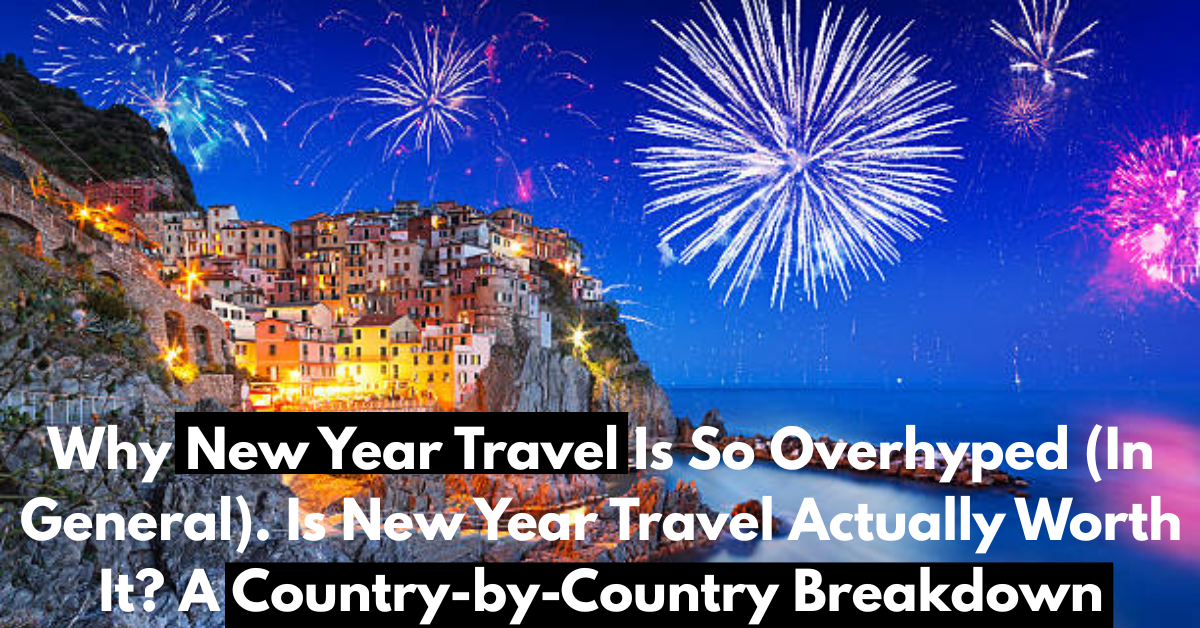
  • Why New Year Travel Is So Overhyped (In General). Is New Year Travel Actually Worth It? A Country-by-Country Breakdown

    Why New Year Travel Is So Overhyped (In General). Is New Year Travel Actually Worth It? A Country-by-Country Breakdown

    Before zooming into specific countries, here’s the universal truth:

    New Year travel is not about sightseeing.
    It’s about being somewhere at midnight.

    That single moment drives:

    • inflated hotel prices
    • overcrowded city centers
    • limited transportation
    • closed attractions the next day
    • exhausted locals who do not want tourists anymore

    If your goal is museums, food, culture, or calm exploration, New Year is usually a bad deal.
    If your goal is vibes, spectacle, and stories, it can be worth it.

    Now let’s talk specifics.

    France (Paris): Romantic Lie, Logistical Nightmare

    The fantasy: Fireworks near the Eiffel Tower.
    The reality: Cold, packed streets, minimal official fireworks, police barriers everywhere.

    Paris does New Year quietly. Most locals celebrate at home or at private parties. Restaurants are booked weeks in advance with fixed menus that cost a kidney. read more

  • Why New Year Is the Worst Time to Set Big Goals (And What to Do Instead)

    Why New Year Is the Worst Time to Set Big Goals (And What to Do Instead)

    January 1st has incredible PR.

    Every year, billions of people collectively decide that this arbitrary midnight is the perfect moment to reinvent their entire personality. New body. New career. New habits. New life. Same fridge, same brain, same unresolved chaos — but somehow this time it’ll work.

    Spoiler: it usually doesn’t.

    By mid-February, gyms are quieter, planners are abandoned, and “This is my year” has quietly become “Let’s survive until March.” This isn’t because people are lazy or weak. It’s because New Year is a terrible time to set big goals, psychologically, biologically, and structurally. read more

  • Countries That Don’t Celebrate New Year on January 1 (And Why)

    Countries That Don’t Celebrate New Year on January 1 (And Why)

    January 1, New Year’s Eve, feels inevitable. Fireworks, countdowns, bad champagne, bold lies to yourself about gym memberships. It feels universal.

    It isn’t.

    January 1 is just one date that won a long, messy fight between empires, religions, astronomers, and bureaucrats who really loved paperwork. Large parts of the world either celebrate New Year on a completely different day—or treat January 1 as a polite formality while saving the real reset for later.

    So let’s peel back the calendar and look at the countries where New Year doesn’t start with “Happy January.” read more

  • Best Places to Spend New Year’s Eve — Not for the Fireworks, but for the Feeling

    Best Places to Spend New Year’s Eve — Not for the Fireworks, but for the Feeling

    Because Fireworks Aren’t the Whole Point

    Every December, New Year’s Eve, the internet loses its collective mind and screams the same advice at you:
    “Go somewhere with BIG fireworks.”

    Cool. You watch lights explode for ten minutes, freeze your hands off, pay triple for a drink, and wake up January 1st wondering why you didn’t just stay home with snacks.

    New Year’s Eve isn’t about fireworks.
    It’s about how you want to feel when the year turns.

    Do you want chaos? Silence? Romance? Reinvention? A hard reset?
    Different places deliver very different vibes — and that’s where most “best places” lists fail. read more

  • How Different Cultures Celebrate New Year’s Eve — And What It Says About Them

    How Different Cultures Celebrate New Year’s Eve — And What It Says About Them

    New Year’s Eve is often marketed as a universal moment — fireworks, countdowns, kisses, and promises we’ll break by February. But the truth is far messier and far more interesting.

    Across the world, New Year’s Eve isn’t just a party. It’s a ritual. A cleansing. A superstition-fueled negotiation with fate. Some cultures smash things. Others eat very specific foods at very specific speeds. A few set things on fire and call it spiritual growth.

    Understanding how countries celebrate New Year’s Eve reveals how they think about luck, time, regret, and fresh starts. Let’s travel the globe, one midnight at a time. read more

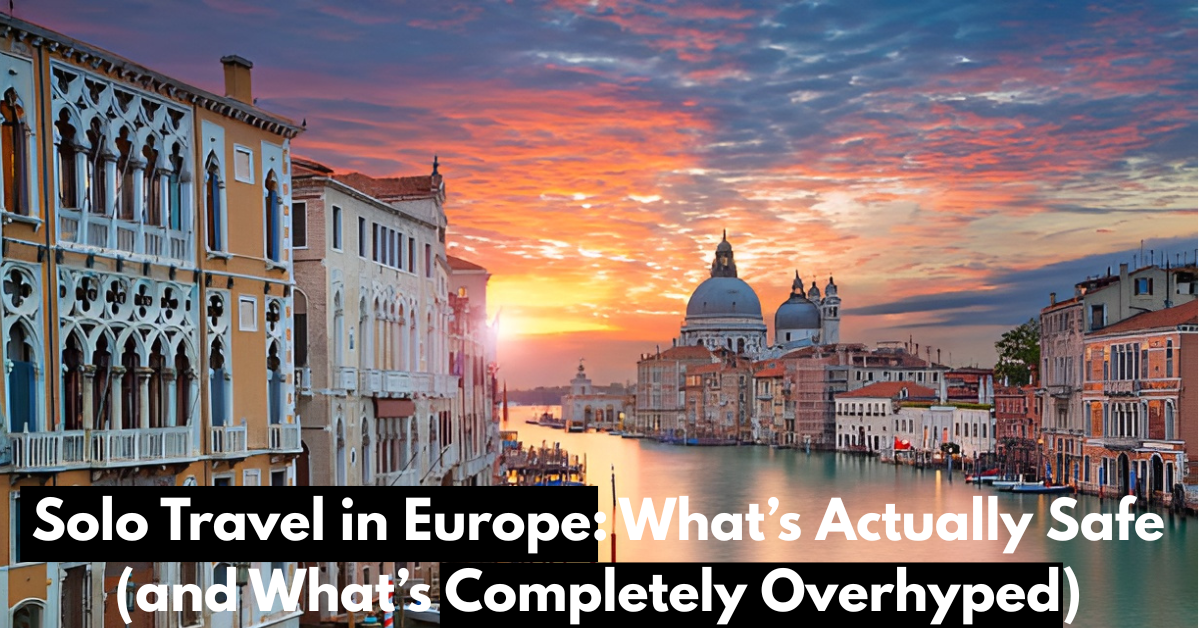
  • Solo Travel in Europe: What’s Actually Safe (and What’s Completely Overhyped)

    Solo Travel in Europe: What’s Actually Safe (and What’s Completely Overhyped)

    Solo travel has a weird reputation.

    To some people, it’s freedom, self-discovery, and eating pasta alone like a mysterious main character.
    To others, it’s apparently a non-stop horror movie involving pickpockets, scammers, and hostile locals waiting behind every corner.

    So let’s clear the fog for Solo Travel in Europe

    Europe is one of the safest regions in the world for solo travelers, but that doesn’t mean every fear is fake — or that every danger is real. Some risks are legit. Others are wildly exaggerated by travel forums, viral TikToks, and that one uncle who hasn’t left his city since 2004.

    Let’s separate reality from overhype.

    What’s Actually Safe (Yes, Really)
    Walking Alone in Major European Cities

    This one shocks people.

    In most cities, walking alone — even at night — is normal, especially in central areas. Cities like Lisbon, Vienna, Prague, Amsterdam, and Copenhagen regularly rank among the safest urban spaces globally.

    People are out late. Streets are lit. Public transport runs well past midnight. You’ll often see families, couples, and solo locals walking around like it’s no big deal — because it isn’t.

    That doesn’t mean you wander blindly into sketchy neighborhoods at 3 a.m. with headphones blasting. It means that being alone does not automatically make you a target.

    Reality check:
    If a place feels safe enough for locals to walk casually, it usually is.

    Public Transport (Trains Especially)

    European trains are a solo traveler’s dream.

    They’re clean, predictable, well-lit, and full of normal people just trying to get somewhere. Long-distance trains in Western and Central Europe are significantly safer than driving long hours alone.

    Night trains get a dramatic reputation, but in reality they’re widely used by students, workers, and tourists. Choose a couchette or sleeper if you want peace of mind, lock your bag, and you’re fine.

    Buses are also generally safe — just less comfortable and more chaotic.

    Hostels (Even If You’re Introverted)

    Hostels sound terrifying if your mental image is drunk backpackers and stolen socks.

    In reality, most European hostels are professionally run, with lockers, key-card access, cameras, and staff who do not tolerate nonsense. Many even offer female-only dorms and private rooms.

    Ironically, hostels are often safer than cheap hotels because there’s always someone around.

    Introverts survive just fine. You’re not required to socialize. Sitting silently with your phone is allowed. No one will report you.

    Eating Alone

    This is not a danger — this is a vibe.

    Europe does not care if you eat alone. Cafés, bakeries, wine bars, and casual restaurants see solo diners constantly. No one is watching you. No one feels sorry for you. No one assumes you were stood up.

    If anything, eating alone in Europe is peak main-character energy.

    What’s Overhyped (Borderline Nonsense)
    “Europe Is Full of Dangerous No-Go Zones”

    Every city has areas that are rougher than others. That’s called reality, not Europe-specific chaos.

    What’s overhyped is the idea that tourists accidentally wander into war zones by taking one wrong turn. Tourist centers are tourist centers for a reason. You don’t randomly teleport into high-risk neighborhoods unless you deliberately go exploring far from common routes.

    Basic rule:
    If the street feels empty, poorly lit, and off-route — turn around. That’s not fear. That’s situational awareness.

    Violent Crime Against Tourists

    Violent crime targeting tourists is rare in Europe, especially compared to many other regions.

    The real issue isn’t violence. It’s petty theft.

    Pickpocketing, bag snatching, and distraction scams are the main problems — and even those are predictable once you know the patterns.

    Which brings us to…

    “Pickpockets Are Everywhere Waiting to Strike”

    Yes, pickpocketing exists.
    No, it is not an omnipresent threat lurking in every bakery.

    Pickpockets focus on:
    • crowded metros
    • busy tourist attractions
    • people distracted by phones
    • open bags and loose pockets

    They are not criminal masterminds. They are opportunists.

    Use zipped bags, keep valuables close, don’t leave your phone on café tables, and you’ve eliminated 90% of the risk.

    Language Barriers

    You will not be stranded because you don’t speak five languages.

    English is widely understood across Europe, especially in cities, transport hubs, and tourist areas. In many countries, people speak better English than native speakers who skip grammar.

    Learning basic phrases is respectful and appreciated — but lack of fluency is not dangerous.

    What You Actually Need to Be Careful About

    Now for the honest part.

    Overconfidence

    Europe feels safe, so travelers sometimes drop their guard entirely.

    That’s when phones get stolen, bags get left behind, and wallets disappear. Comfort should not become carelessness.

    Confidence is good. Complacency is expensive.

    Tourist Scams (They’re Boring, Not Dangerous)

    Bracelet scams, fake petitions, “helpful” strangers offering directions — these are not violent threats. They’re mild annoyances designed to separate you from a few euros.

    Ignore, don’t engage, keep walking. The end.

    Burnout (The Real Solo Travel Killer)

    Solo travel exhaustion is real.

    Too many cities. Too many museums. Too much pressure to “make it worth it.” Burnout leads to poor decisions, missed trains, and general misery.

    The safest solo traveler is the one who sleeps, eats properly, and doesn’t treat travel like a competitive sport.

    So… Is Solo Travel in Europe Actually Safe?

    Yes. Undeniably. Statistically and socially.

    Europe is one of the easiest places on Earth to travel alone — especially for first-time solo travelers. The systems work. The infrastructure helps you. The culture does not single you out.

    The danger is not Europe.
    The danger is misinformation, exaggeration, and letting fear steal experiences you’ll regret skipping later.

    Travel smart. Stay aware. Trust your instincts.
    And don’t let overhyped fear rob you of one of the best ways to see the world — on your own terms.

    Solo doesn’t mean unsafe.
    It means uninterrupted freedom. read more
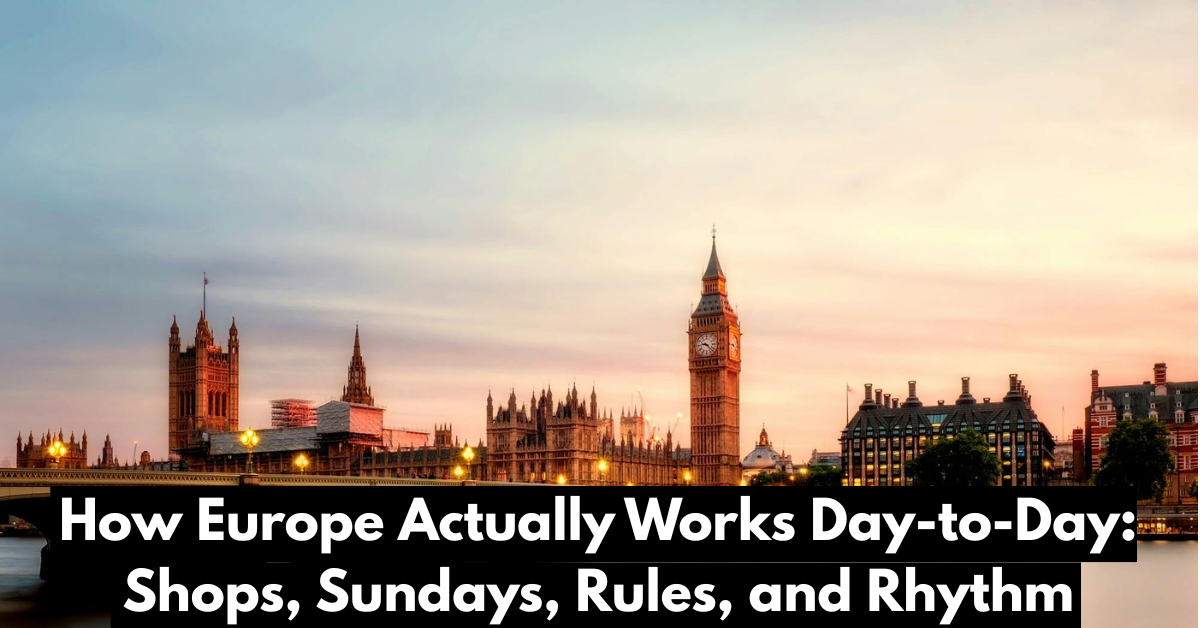
  • How Europe Actually Works Day-to-Day: Shops, Sundays, Rules, and Rhythm

    How Europe Actually Works Day-to-Day: Shops, Sundays, Rules, and Rhythm

    “The streets of Europe are a tourist’s paradise—cobblestone streets, historic buildings that are centuries old, and food so good it’s almost criminal. But the first thing any newbie tourist will tell you is, ‘You know what would be even better? If all the businesses were actually open

    Europe is no more chaotic than other places, it just has its own tempo. Once you realize how things work in this country, everything falls into place: shopping, Sundays, breaks, rules, and the pulse of every country. read more

  • Paris vs Rome vs Barcelona: Which 1 City Is Right for Your Travel Style?

    Paris vs Rome vs Barcelona: Which 1 City Is Right for Your Travel Style?

    Every year, millions of travelers stare at the same three names like they’re choosing a starter Pokémon.

    Paris.
    Rome.
    Barcelona.

    All legendary. All iconic. All capable of delivering the trip of a lifetime… or quietly ruining it if you pick the wrong one for who you are.

    Because here’s the uncomfortable truth no travel brochure will tell you:
    these cities are wildly different personalities wearing equally famous outfits. The travel styles are different.

    This guide isn’t about “which city is better.”
    It’s about which city fits you. read more

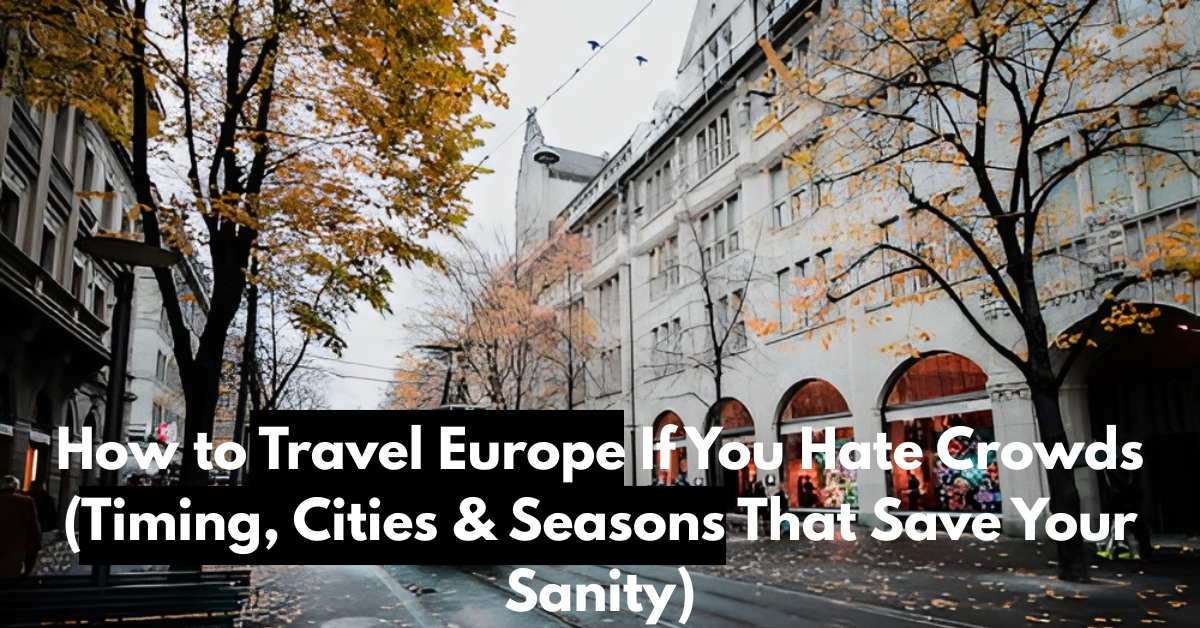
  • How to Travel Europe If You Hate Crowds (Timing, Cities & Seasons That Save Your Sanity)

    How to Travel Europe If You Hate Crowds (Timing, Cities & Seasons That Save Your Sanity)

    Europe is incredible.
    Europe is also loud, packed, and occasionally feels like a human sardine can with gelato.

    If the idea of shoulder-to-shoulder sightseeing makes your soul leave your body, this guide is for you. You don’t hate Europe — you just hate crowds. Luckily, Europe has options. You just need to travel smarter than the average summer tourist.

    Let’s fix this.

    The Biggest Mistake: Traveling When Everyone Else Does

    Summer is the enemy of crowd-free Europe.

    July and August combine:

    • school holidays
    • cruise ship season
    • peak pricing
    • peak temperatures
    • peak irritation

    Cities don’t just get busy — they get overwhelmed. Locals leave. Infrastructure strains. What should feel romantic starts feeling logistical. read more

  • How to Choose the Right European SIM or eSIM Without Overpaying

    How to Choose the Right European SIM or eSIM Without Overpaying

    Buying mobile data in Europe should be simple. You’re in 2025. Satellites exist. AI exists. Yet somehow, the moment you land, you’re standing in an airport staring at a European SIM card wall like it’s a personality test.

    One option costs €10. Another costs €40. One says “unlimited.” Another says “EU roaming included*” with an asterisk that screams danger.

    Let’s fix this once and for all.

    Why This Decision Actually Matters

    Your SIM choice affects more than just Instagram uploads.

    Bad data plans mean:

    • Maps not loading when you’re lost
    • Ride apps failing at the worst moment
    • Paying roaming charges that feel legally suspicious
    • Burning through data because your plan wasn’t meant for travel

    Good connectivity quietly makes your trip smoother. Bad connectivity turns minor inconveniences into rage-filled core memories. read more